
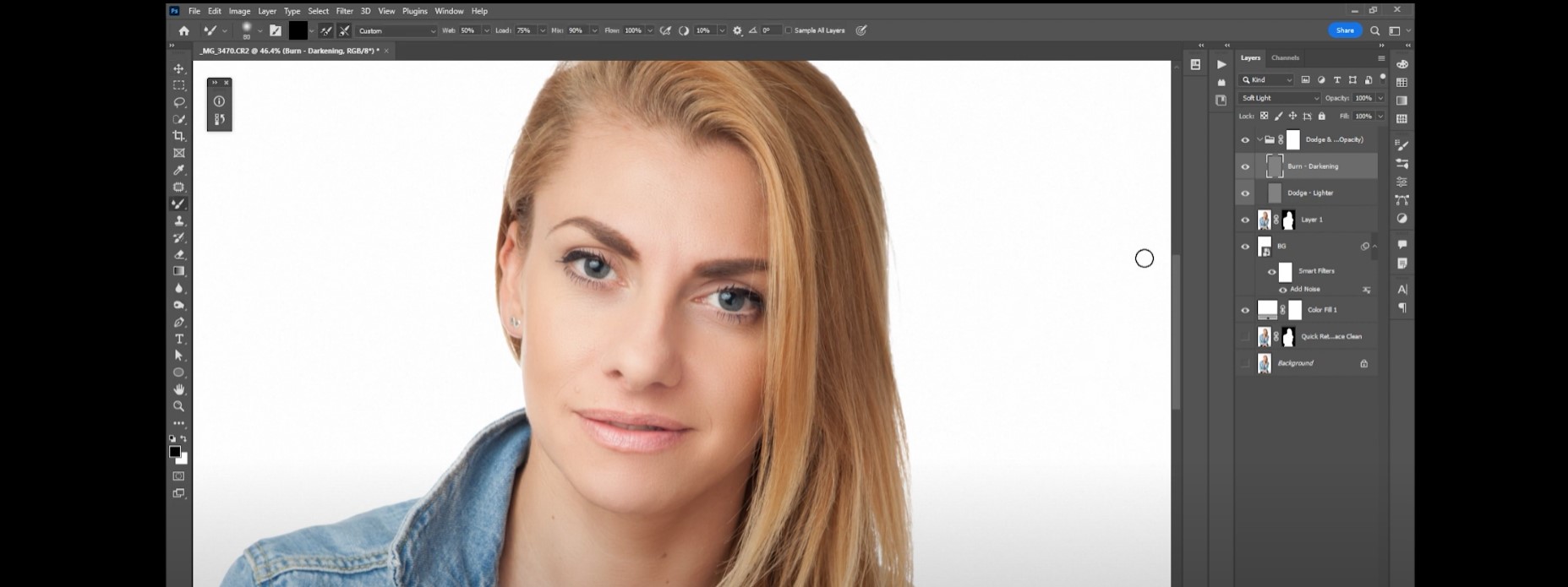
A simple, repeatable workflow for retouching portraits: a custom Quick Retouch action to do the groundwork, frequency separation to clean the skin without flattening it, and dodging and burning to put the shape back. The action is free to download at the end.
Step 1 — The Quick Retouch action
The action applies the groundwork in one click: it enhances the skin, separates the background, creates the dodge and burn layers and smooths the skin. Select it in the Actions panel and press play. In seconds the photo is meaningfully improved — the difference between before and after is immediate, and everything that follows is refinement rather than repair.
Step 2 — Frequency separation
Frequency separation is what I use when a client wants a polished, commercial finish. It splits texture from colour so you can work on each independently, which is how you get skin that is even without looking plastic.
Setting it up
Duplicate the layer twice and name the copies Low Frequency and High Frequency. Apply a Gaussian blur to the low-frequency layer until the texture disappears, then set the high-frequency layer’s blending mode to Linear Light and apply Apply Image with blending set to Subtract, scale 2, offset 128.
Working the layers
On the low-frequency layer, use a soft brush at low opacity and flow to even out colour variation and blotchy shadows. On the high-frequency layer, use the healing brush or clone stamp for spots and lines. Keep the two jobs separate — that separation is the whole point of the technique.
Step 3 — Dodging and burning
Dodging and burning is what returns depth to a face after the skin work has flattened it. You are lightening and darkening specific areas to rebuild the structure the retouching softened.
Create two new layers named Dodge and Burn, fill both with 50% grey and set their blending mode to Overlay — they stay invisible until you paint on them.
Paint with a soft white brush at low opacity on the dodge layer over the eyes, the bridge of the nose, the cheekbones and the lips. Paint with soft black on the burn layer under the eyes, along the sides of the nose and beneath the jaw. Build it up slowly; if you can see where you painted, you have gone too far.
What this gets you
Quick Retouch for the groundwork, frequency separation for the skin, dodging and burning for the shape. Three steps, in that order, and a portrait that holds up at print size. Most of the skill is in restraint — the goal is a photograph of a person, not of retouching.
Download the action
The Quick Retouch action is free. If it saves you time and you want to say thanks, there is a coffee button next to it.